Wayne Chichansky, Vice President of Search Strategy at iQuanti, shares actionable insights on building AI-ready content, stronger authority, and greater digital visibility.
When an AI assistant recommends a brand, it isn’t making a random choice. Behind every response is a process of retrieving, evaluating, filtering, and validating information from across the web before deciding which sources deserve to be cited. For banks, that means visibility is no longer determined solely by where they rank in search results. It depends on whether AI considers them credible enough to include in the answer. The challenge is no longer simply getting found. It’s earning the confidence of AI systems that increasingly shape customer decisions.
This shift represents more than another search algorithm update. It fundamentally changes how banks earn visibility and trust online. Our latest webinar, The 2025-2026 LLM Shift: What It Means to You, outlined why AI visibility has become a strategic priority and what financial institutions should do to compete in this new environment.
Search Has Changed. Discovery Has Changed.
Generative AI has become one of the fastest-adopted technologies in history, and consumer behavior is changing with it. More people are asking AI platforms for recommendations, explanations, and comparisons before visiting a bank’s website. Financial institutions can no longer rely on Google rankings alone to reach prospective customers. That does not mean SEO is obsolete.
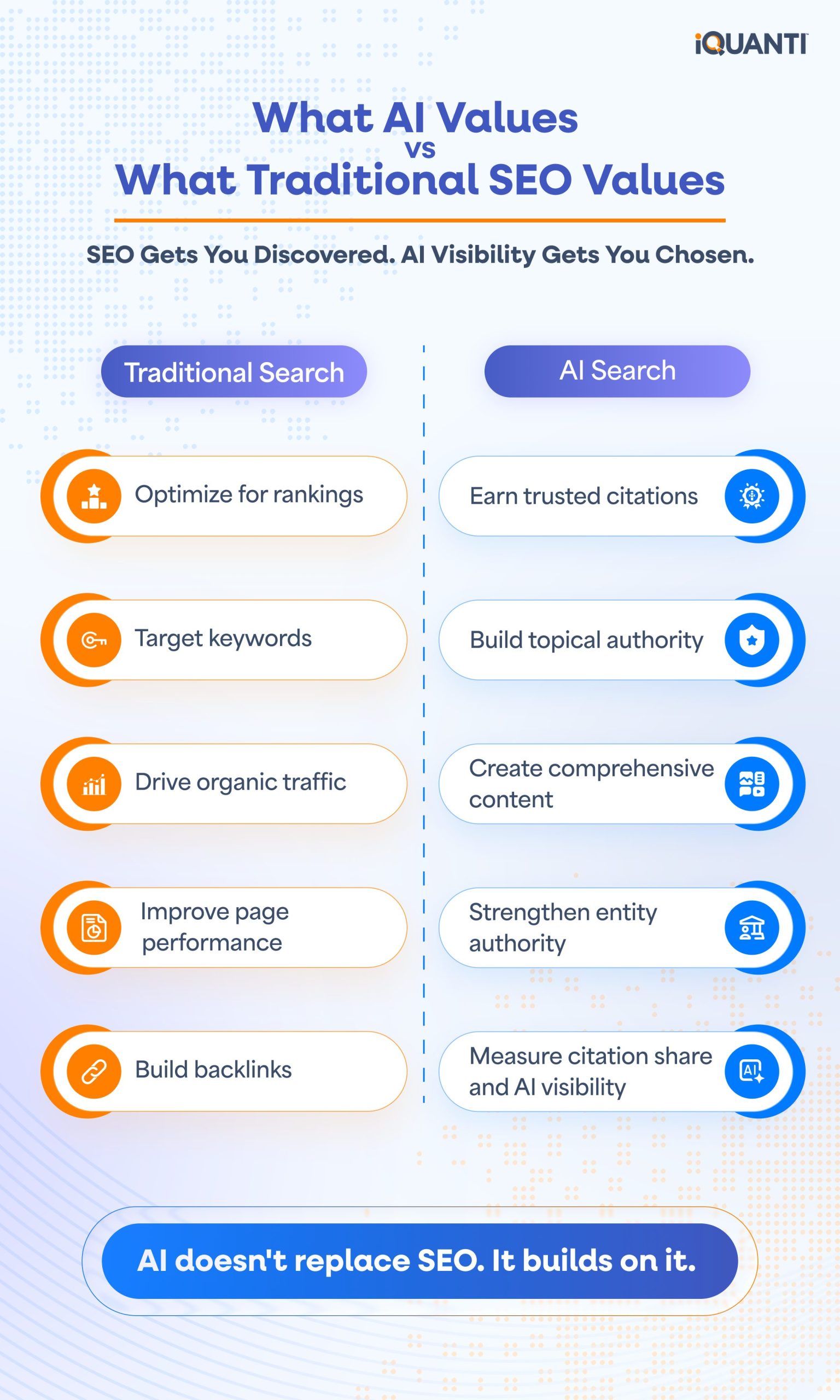
One of the webinar’s most important clarifications was that SEO remains the foundation of AI visibility. Strong technical optimization, content quality, and search rankings continue to influence whether content is discovered by AI systems. However, those factors alone are no longer enough. AI platforms apply additional layers of evaluation before deciding which sources deserve to appear in their answers.
AI Doesn’t Rank Pages. It Selects Sources.
Traditional search engines organize information by ranking webpages. AI models follow a very different process. Every query passes through four stages. The AI first interprets the user’s intent, retrieves potentially relevant information, filters sources using multiple quality signals, and finally synthesizes an answer from the content it considers most trustworthy. Brands that fail during retrieval or filtering never make it into the final response, regardless of how well they rank elsewhere.
This is why AI visibility is fundamentally different from search visibility. Success is no longer about appearing somewhere on page one. It is about becoming one of the few sources AI trusts enough to cite.
Comprehensive Content Is Replacing Thin Content
One of the biggest reasons traditional banks lose visibility is content that stops at answering the obvious question. AI expects much more. Instead of simply defining a financial product, AI-generated answers anticipate related questions, explain edge cases, address implied concerns, and guide users through the broader decision-making process. Content that only satisfies the primary search intent often falls short because it lacks the depth AI needs to build a complete response.
The webinar introduced a practical framework for evaluating AI-ready content through four characteristics:
- Retrievable: Can AI easily discover your content?
- Extractable: Is the information structured so AI can identify and reuse individual sections?
- Citable: Does every statement stand on its own with factual, specific information?
- Inspirational: Does the content demonstrate enough authority to become part of an AI knowledge base over time?
This framework encourages brands to think beyond keywords and focus on creating content AI can confidently understand, reference, and reuse.
Your Website Is Only Part of the Equation
Perhaps the biggest mindset shift discussed during the webinar was the growing importance of entity authority. Domain authority still matters because it helps content enter the retrieval process. However, AI platforms also evaluate the overall strength of a brand across the digital ecosystem. Media coverage, social validation, third-party mentions, industry publications, and consistent messaging all contribute to how AI determines credibility. That changes AI optimization from a channel-specific initiative into an organization-wide effort.
SEO teams cannot build AI visibility alone. Brand, PR, content, communications, and digital marketing teams all influence the signals AI uses to determine which organizations deserve to be cited.
Third-Party Validation Is Becoming a Ranking Factor for AI
The webinar also highlighted a significant shift in how authority is established. AI models frequently rely on trusted third-party websites to validate information before generating answers. Depending on the prompt, platforms such as NerdWallet, Bankrate, Credit Karma, Experian, and even Reddit can influence whether a financial institution appears in AI-generated responses. Importantly, those influential sources vary by topic and prompt cluster, making it essential for brands to understand which external publishers shape the conversations that matter most to their business. This makes digital PR, earned media, partnerships, and third-party brand mentions increasingly valuable components of an AI visibility strategy.
Preparing for an Agent-Driven Future
The webinar looked beyond today’s AI experiences toward the rise of autonomous AI agents. The next phase of AI isn’t just about better answers. It’s about completing tasks. As AI agents begin researching providers, comparing products, submitting applications, and carrying out transactions on behalf of users, banks will need websites that machines can navigate as easily as people do. Organizations that aren’t prepared for these AI-driven interactions risk being bypassed before a customer ever reaches their website.
Measuring Success Requires New Metrics
The metrics used to evaluate SEO performance are no longer enough to measure AI visibility. The webinar recommends expanding measurement beyond rankings and organic traffic to include citation share, prompt coverage, AI-assisted conversions, brand visibility, share of voice, and business impact. These metrics help organizations understand not only whether they appear in AI responses but also how AI visibility contributes to awareness, engagement, and conversions. Taken together, these KPIs provide a more complete picture of how AI is influencing customer discovery and business outcomes.
Building an AI Visibility Strategy
For organizations beginning their AI optimization journey, the webinar outlined three practical priorities. First, audit existing content against the prompts customers are asking AI platforms and identify gaps in coverage. Second, optimize content so it is comprehensive, structured, and designed for AI retrieval and citation. Finally, strengthen entity authority by earning visibility across the third-party sources that influence AI-generated answers. These actions strengthen existing SEO strategies while expanding visibility across both search engines and AI platforms.
The Road Ahead
AI search is not replacing traditional search overnight, but it is rapidly changing how consumers discover financial brands. Organizations that continue optimizing exclusively for rankings risk overlooking a growing channel where buying decisions increasingly begin.
The opportunity lies in combining strong SEO fundamentals with comprehensive content, trusted brand authority, meaningful third-party validation, and measurement frameworks built for AI-first discovery. The brands that succeed will not simply rank well. They will become the sources AI trusts to answer its users’ questions.
This article is based on insights from our webinar, Check out the webinar to explore the complete discussion and key strategies. To explore how financial brands can win with a holistic search framework in the AI era, get in touch.