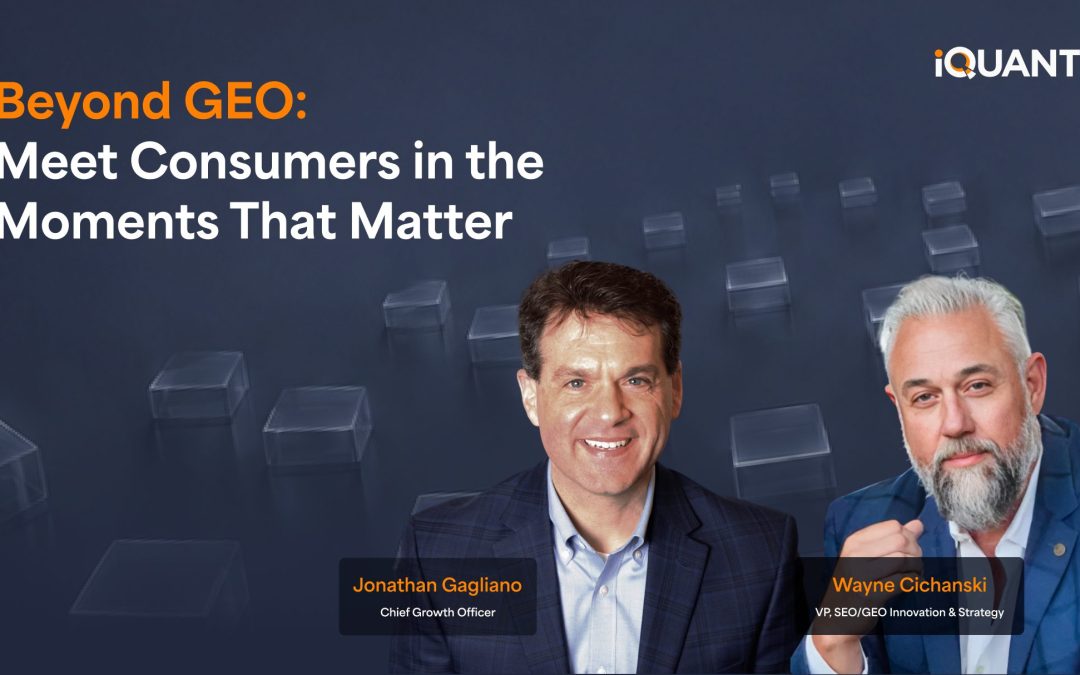
An adaptation of iQuanti’s DMFS NYC session with Jonathan Gagliano, Chief Growth Officer, and Wayne Cichanski, VP, SEO/GEO Innovation & Strategy.
“Why aren’t we showing up?” “How can we get better visibility?” Marketing leaders hear these questions every week, and with every new AI tool, the instinct is to treat it as the next channel to master. At iQuanti, we see a different path. In our DMFS NYC session, “Going Beyond GEO,” Jonathan and Wayne shared a simple principle: brands that chase every new AI surface will always be trying to catch up. Whereas, brands that build advocacy around the customer journey will stay relevant no matter what comes next.
Jonathan, as Chief Growth Officer, explored the strategic shift financial services marketers need to make. Wayne, as VP of Solutions, showed how that shift comes to life in practice and how iQuanti’s iQ.IMPACT™ platform puts it to work. What follows is an adaptation of that conversation.
The reframe: stop chasing surfaces
The conversation began with a line Jonathan called one of his favorites: “There is a lot of risk in chasing the new platform and letting the technology obscure the consumer.”
The consumer financial brands want to reach is navigating wage pressure, job uncertainty, and financial products that keep growing more complex. They are looking for help that is relevant and connected, and they want it “perfectly timed, perfectly placed, and seamlessly facilitated.”
This is also where the idea of “the brand of one, the brand of me” comes in. Consumers are using AI to shape their own financial experience, and our research shows the motivation isn’t mainly the technology or even the convenience. “It’s mostly about seeking true end-to-end personalization,” Jonathan said, “and we as brands haven’t fully brought that to bear.”
Industry data reflects how quickly this is unfolding. TD Bank’s 2026 AI Insights Report found that 78% of Americans now use AI-enabled tools in their daily lives, and 67% say they are more proficient than they were a year ago. The shift is sharpest in personal finance: only 10% of consumers used AI to help manage their finances last year, compared with 55% today, with Gen Z at 77% and Millennials at 72%. SoFi’s 2026 survey shows a similar pattern among investors, where three in four use AI for investing questions, and 86% of those users have made an investing decision based on AI-generated insights. Trust, however, is still being earned. TD found that only 18% of respondents would trust AI to make financial recommendations on its own.
We see three shifts at the heart of this reframe. The first is moving from technology to audience-based journeys: “We will forever be chasing the next surface if that’s our focus.” The second is moving from channels to an integrated approach, since brand, PR, the contact center, media, and CRM all shape whether a brand reaches the right customer at the right time. The third is moving from trying to be everywhere to showing up in “micro moments of advocacy.”
“So when we often talk about showing up and being visible and being findable,” Jonathan said, “it actually really means showing up for the consumer.”
Context is personalizing the answers
From strategy, the conversation turned to mechanics, beginning with a change many marketers haven’t fully accounted for yet. As people bring more of their lives into AI tools through memory, connected email, photos, and location, the answers they receive begin to differ from person to person.
“Because the LLM understands more about who you are, more about the context of your question,” Wayne explained, “the answers become personalized.”
That opens up a new question for marketers. “What if as a marketer we knew different life moments and where the search started? A new job, a baby on the way. What if we knew that information weeks or months before it’s actually happening?”
Search has always been reactive, since a query reflects something that has already happened. The purchase decision, though, begins much earlier, in need states and use cases, before a consumer has any product in mind. “If your only goal is to drive acquisition at the bottom funnel, and you really are just focused on showing up at the rate table, you’ve lost the majority of the battle.”
Do you really know your audience?
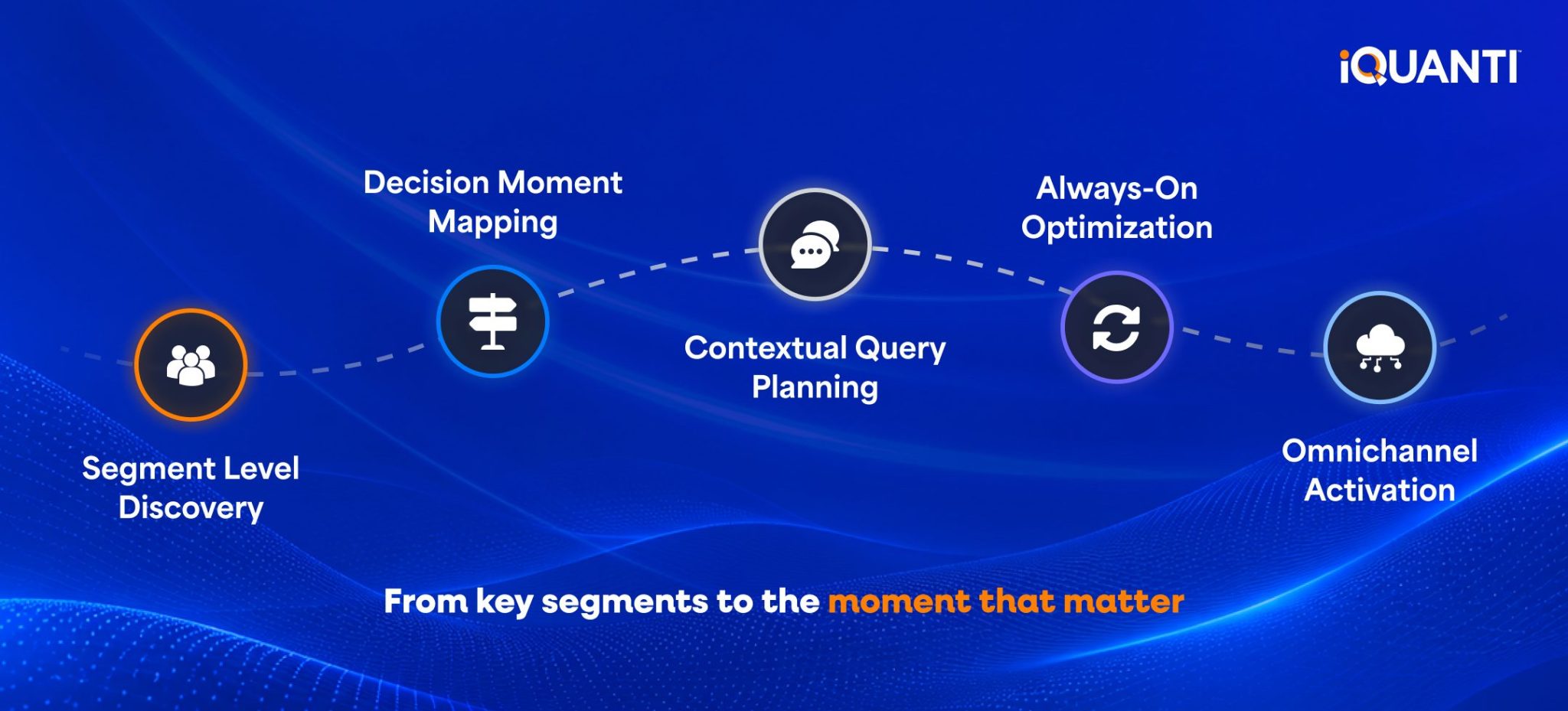
This is where iQ.IMPACT comes in. In most organizations, marketing data sources operate in isolation: keyword data, prompt volume, social chatter, first-party CRM data, and third-party data are each analyzed on their own. “That’s the flaw in the system,” Wayne said. “When we look at an originated data source and we create an action on it, we are doing it kind of with blinders.”
iQ.IMPACT layers these sources together and uses AI to find correlations and patterns across them, so each source strengthens what the others reveal. The result is a generative audience profile built on real demand signals rather than assumptions.
That distinction matters more than many brands realize. “Everybody has an audience of some sort that they think that they’re targeting. And the reason I emphasize think is because often times they don’t know.” In one engagement, a client’s two main segments matched the data closely, but the analysis also surfaced “a complete segment C altogether” that had gone unaddressed.
These profiles go well beyond demographics. They capture the trigger that brought someone into the market (a drop in credit score, a rejected application, a high-interest bill), the people who influence the decision, and how the brand should speak to them. For a credit-rebuilding segment, the tone needs to be “non-judgmental, factual, and educational,” and brands should “avoid aspirational luxury.” This has a direct bearing on GEO, because a page optimized for prompts still needs to speak in the right voice for the segment reading it.
The pre-product journey
We call the earliest stage of discovery the pre-product journey. Here, the consumer doesn’t yet know your product or your bank exists. They simply have a problem, and they ask questions like “How do I build credit from scratch with no credit history?” or “What is a good credit utilization ratio to have?”
“All of these questions, they’re not mentioning a product,” Wayne said. “But these are important parts of discovery, important parts of the journey that your brand has got to identify, match to the audience, map it back to your content, and say, ‘Do I have this covered?’”
The SoFi data helps explain why so many of these conversations happen inside AI tools. Nearly half of AI users say they turn to AI because they feel uncomfortable asking others financial questions. Many consumers are working through their most sensitive money questions privately, often before they ever reach a brand’s website
How AI answers are built and why entity authority matters
One of the most important differences between traditional search and AI answers lies in how they are assembled. “Google matches core intent. AI answers do not. They answer core intent, but they answer edge cases, implied questions, fan-out queries.” An AI-generated answer draws on many sources at once: credit bureaus, card issuers, financial publishers like NerdWallet and Bankrate, comparison sites, media outlets like Forbes, video, Reddit, and Google’s own results.
This is why entity authority sits at the center of our approach. “Unlike the backlinks that Google does, the entity authority is actually looking at citations and brand mentions across all kinds of third-party publishers.” Put simply, “what you do off the website means even more than what you do on the website.”
None of this replaces SEO. “This isn’t an or statement. This is really an and statement. You need SEO as your foundation to drive the AI answers.”
Going horizontal
The operating model that ties all of this together is horizontal planning. Take a brand aiming to win the topic “build your credit score.” The product page and blog content are only the beginning. Organic and paid social should support the same topic, and so should paid search. Comms teams can shift from press releases toward earning branded and non-branded citations on that topic. Affiliate investment can follow the publications that actually influence AI answers.
“You have to do that for every topic and every line of business,” Wayne said.
The results bear this out. In our client work, this approach has delivered 18 to 25% more accounts opened on flat or lower spend, largely because channels stop working in silos. “Every channel carries one topic and focus. You get this halo effect.” Consistency also shapes how AI understands a brand: “The LLMs are not going to create a hallucination just because you want to say something different.”
Measuring the echo
Measurement remains one of the most common questions we hear. The marketing teams already track rankings, traffic, citation share, and engagement, which still matter, but they miss the combined effect. We call this the “echo effect,” a GEO multi-touch attribution model designed to account for “the visits and accounts that no single channel can claim.”
Is your site ready for agents?
Looking ahead, consumer use of AI is moving through clear stages. Many are still using it for Q&A, some have moved into generation, and a growing number are beginning to use agentic commerce, where AI acts and transacts on their behalf. “It’s low now, but I guarantee you this is a hockey stick,” Wayne said. “Can somebody create an app start through an agent, or do you have that blocked?”
Where to start
The approach comes down to three strategic moves:
Lead with the audience. Let real segment data drive personalization, tone, and how you communicate.
Plan horizontally. Entity authority is built across every channel, not within one.
Act in moments of advocacy. Find where decisions actually begin, often well before a product is in view, and make sure your brand is part of that conversation.
Beneath those moves is the practical work: baselining brand visibility, connecting data signals, mapping audiences to content and journey gaps, and preparing the site for agentic commerce.
As Jonathan put it: “The technology serves. The technology is not what we are trying to chase.”
Want to know where your brand shows up in AI answers, and which audiences you might be missing? Get in Touch to what iQ.IMPACT can uncover.