Matthew DiBenedetti, SVP, Creative and Experience at iQuanti, explores how AI can help financial services scale content while maintaining quality and compliance.
How can financial services manage growing content demand and compliance? Marketing leaders across the banking and finance industry are confronting a growing content challenge: producing and maintaining relevant, high-quality content at scale while ensuring it meets compliance requirements and reaches the market efficiently. As organizations manage content across extensive digital properties, the challenge is not simply keeping pages updated. It is maintaining accuracy and quality as the volume and pace of content production increase, while navigating the review processes required in financial services.
AI can help address this challenge by supporting multiple stages of the content process, but greater production capacity alone is not enough. This was the focus of the webinar titled Faster, Better, Compliant, Scaling Content with AI for Banking and Financial Services, featuring Matthew DiBenedetti, SVP, Creative and Experience at iQuanti. He explored how AI can support content discovery, development, review, compliance, and delivery to improve efficiency, quality, and speed to market.
The Financial Content Challenge: Speed, Quality, and Compliance
Financial services organizations are facing a growing need to produce relevant, high-quality content at scale while managing compliance review and getting content to market efficiently. Matthew identified these as connected challenges within the content process.
- Growing Content Demand: Organizations need to determine what content audiences need and produce it at scale.
- Quality at Scale: Simply generating content with AI may not deliver the quality or impact possible through a more structured process.
- Compliance Review: Compliance can become a bottleneck, particularly when additional rounds of review are required.
- Human Oversight: Experienced writers and editors with an understanding of regulatory requirements remain part of the review process.
- Faster Delivery: AI-enabled workflows can help reduce the time required to move content through the process and toward market.
The webinar’s approach is therefore not about removing compliance or human review. It is about using AI and automation to make the overall content process more efficient while maintaining the quality and oversight required for financial services.
Start with what the audience needs
The first step in scaling content is identifying where the demand exists. An always-on listening approach can analyze LLMs and AI platforms, social channels, news, and the broader web to surface themes, audience priorities, and content gaps. The objective is to identify themes, understand audience priorities, and uncover opportunities for new or improved content. These insights can then be used to identify and prioritize content gaps.
| Insight | Application |
| Emerging themes | Identify areas that may require content |
| Audience priorities | Understand what audiences are looking for |
| Content gaps | Determine where new or optimized content is needed |
| Priority themes | Focus content development on the most relevant opportunities |
| Content formats | Determine whether an opportunity is suited to an article, infographic, or video |
The approach can also identify sub-audiences and their different priorities. These insights can then inform activity across paid media, email, direct mail, and the onsite experience.
Better inputs can improve AI-generated content
Once a content opportunity has been identified, the next step is to give AI the context it needs to produce a stronger output. Matthew recommended building a detailed content brief that brings together the audience, brand, products, market differentiation, industry, and competitor information.
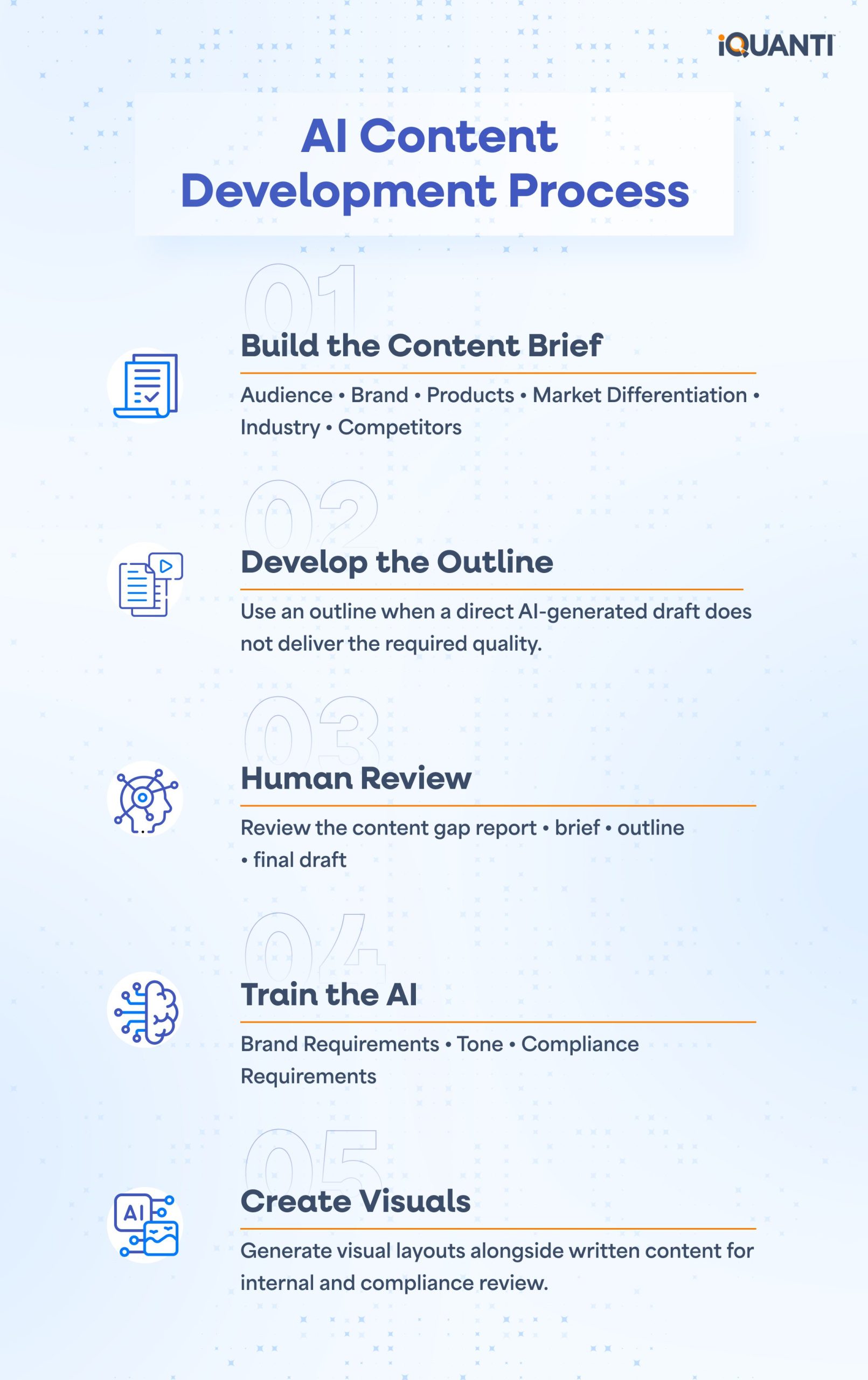
This is important because simply asking AI to generate content may produce an output that addresses the basic requirements without achieving the quality or impact possible through a more structured process. AI does not remove the need for human review. The speaker also describes human involvement across the workflow, including review of:
- Content gap reports
- Content briefs
- Content outlines
- Final content drafts
Experienced writers and editors who understand regulatory requirements remain important for reviewing content for accuracy.
Training AI With Organizational Knowledge
The AI solution also needs to understand the organization’s requirements. Matthew recommended training enterprise AI around brand requirements, tone, and compliance requirements, with that information updated as requirements evolve, similar to maintaining a style guide.
The approach can extend beyond written content. Matthew discussed generating visual layouts alongside written content so teams can review how an asset may appear in market, including during internal and compliance reviews.
The underlying point is straightforward: simply asking AI to generate content may meet basic requirements without delivering the quality or impact possible through a more structured process.
Bringing compliance into the workflow
Compliance is an important part of financial services content production. Rather than treating legal and compliance teams only as a downstream review function, Matthew discussed working with them as partners in the process. Compliance can be built into the content workflow through a QA agent that flags potential compliance concerns for review. The purpose is not to replace human oversight. Instead, the agent can help identify potential issues and reduce unnecessary rounds in a process that can otherwise be lengthy.
Connecting content creation to delivery
Matthew discussed applying AI to individual steps as well as considering an end-to-end agentic workflow, where one stage of the process can lead to the next. Structured content can also be pushed automatically into a CMS, reducing manual steps between content production and publishing. The two potential efficiency gains include:
| AI-enabled approach | Efficiency discussed |
| Effective AI use | 35% average time reduction |
| End-to-end agentic workflow | 50%+ time savings |
What this means for financial services content teams
AI is giving financial services marketers a way to rethink how content gets identified, developed, reviewed, and delivered. But the webinar makes clear that scale alone is not the objective. The value comes from using AI across the process to identify valuable content opportunities, automate production, improve LLM visibility, reduce time to market, and maintain the quality of the final output.
The efficiency gains discussed reinforce the opportunity: effective AI use can reduce time by an average of 35%, while an end-to-end agentic workflow can save upwards of 50% of the time involved in the content process. For financial services marketers, the next step is building a process that allows AI to increase speed and scale while human expertise continues to provide the review and judgment needed to deliver high-quality content.
This article is based on insights from our webinar, Check out the webinar to explore the complete discussion and key strategies. To explore how financial brands can win with a holistic search framework in the AI era, get in touch.