Vishal Maru, VP of Solutions at iQuanti, shares how financial services brands can move from ad-hoc AI experimentation to building scalable, intelligent systems that drive measurable conversion performance.
During a recent iQuanti webinar, Vishal Maru, VP of Solutions and lead of iQuanti’s AI-powered website optimization platform LEAP, unpacked one of the most pressing challenges facing financial services marketers today: high-intent traffic that still doesn’t convert. The session explored why most AI adoption in marketing is creating noise rather than results and what it actually takes to build AI systems that compound over time.
When AI-Generated Pages Look Good But Don’t Work
A financial services brand recently came to iQuanti with a landing page designed entirely by AI. On the surface, it looked polished. But beneath the aesthetic, it had critical gaps: it didn’t align with the specific intent of the user, failed to articulate key product differentiators against competitors, didn’t address the objections their personas typically raise, and wasn’t even on brand.
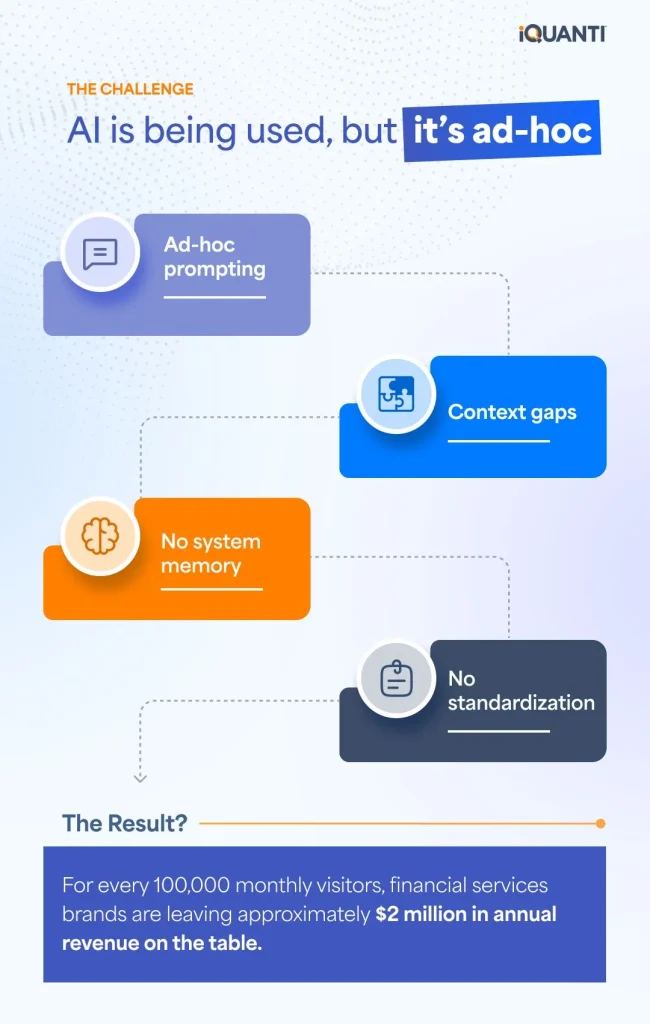
This story is not an outlier. It reflects a pattern iQuanti sees across the industry: AI is being used, but it’s not translating into meaningful business outcomes. Most organizations are using AI in an ad-hoc way, and the result is chaos, not better decisions, not better conversions.
The $2 Million Missed Opportunity
Here’s the scale of the problem. When a new campaign launches and drives significant traffic, the expected conversions don’t materialize. Different teams run different analyses over several weeks. By the time they align on recommendations, delays from technology bottlenecks and competing priorities have already cost valuable momentum.
The underlying culprits are consistent: fragmented data, slow manual analysis, subjective decision-making, and execution gaps. iQuanti’s research calculates that for every 100,000 monthly visitors, financial services brands are leaving approximately $2 million in annual revenue on the table.
Where Most Organizations Are on the AI Maturity Curve
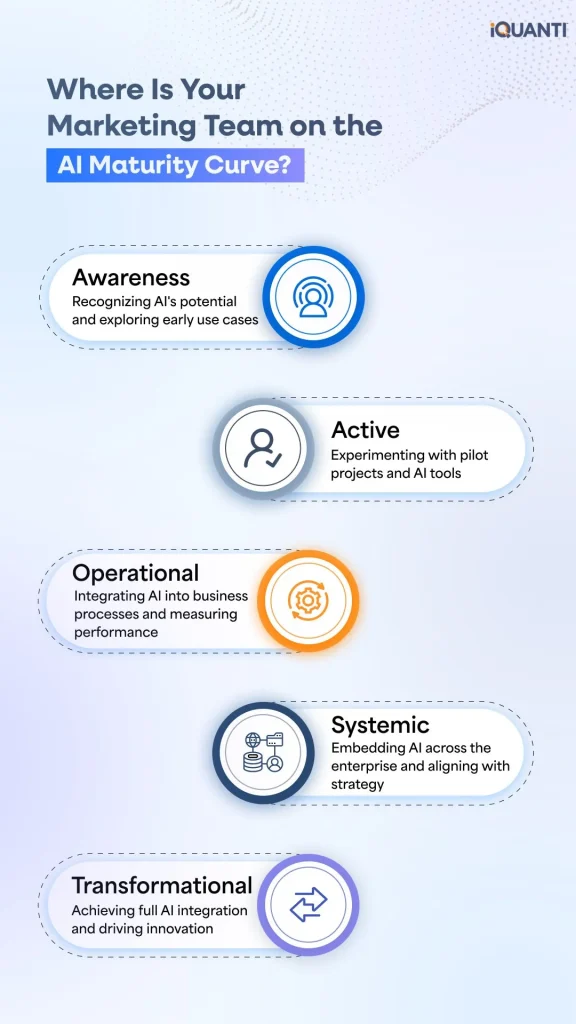
To contextualize the challenge, the session walked through the AI maturity curve, from basic awareness and early use case exploration, through active piloting and operationalization, toward embedded and ultimately transformational AI.
A live poll during the webinar revealed that 64% of attendees were at the awareness stage, with only 21% actively piloting AI in their marketing workflows. This means the majority of financial services marketers are still in the earliest phases of a journey that has significant upside if approached correctly.
Three Pillars of Scalable AI-Led Performance
The core of iQuanti’s framework is a three-pillar architecture for building AI systems that actually work at scale.
Pillar 1: Intelligence: Giving AI the Context It Needs
LLMs have broad general reasoning capabilities, but they lack knowledge of your specific products, segments, personas, and business challenges. Closing that gap is what the Intelligence pillar is about.
By injecting rich context into prompts, which is personas and pain points, product differentiation, brand guidelines, competitive positioning, marketers can dramatically improve the quality and relevance of AI outputs. One effective approach is to build context layers using structured formats such as markdown files (.md), which are easy for LLMs to read and parse.
The result: outputs that are persona-ready and far closer to deployment-quality, rather than requiring heavy manual cleanup.
Pillar 2: Execution: Agents, Workflows, and Tools
This is where AI moves from generating ideas to taking action. Execution maturity can be viewed across three key layers:
Automation agents handle routine, repeatable tasks like competitive analysis monitoring or pulling performance data that previously required manual effort.
Specialized agents bring deeper reasoning to complex tasks. Think of a UX strategist agent that evaluates page experiences, or a legal and compliance agent that reviews marketing copy before it goes live.
AI tools already exist in the market for research, rapid analysis, and prototyping and should be integrated into existing workflows where they add speed.
Agentic workflows represent the most mature layer, orchestrating multiple agents and tools to handle end-to-end processes with minimal human intervention. This is where AI starts to truly compound.
Pillar 3: Trust: The Non-Negotiable for Financial Services
In financial services, the quality and reliability of AI output carries real stakes. The Trust pillar addresses this directly through three mechanisms:
- Human in the loop (HITL): AI can automate much of the work, but human judgment must remain at critical decision points, especially when output will directly influence consumer financial decisions.
- Governance: Clear rules around what data can be used with LLMs, which agents have access to which systems, and which users can interact with which tools. Without governance, AI adoption creates as many risks as it resolves.
- Evals: Unlike binary software outcomes, LLM outputs exist on a quality spectrum. Evaluation frameworks that continuously assess the accuracy, relevance, and quality of AI-generated content are essential for maintaining standards at scale.
How iQuanti Solves This: Introducing LEAP
LEAP is iQuanti’s proprietary AI-led platform for website conversion optimization, built on the three-pillar architecture described above.
At its foundation is a conversion scoring model trained on 100+ conversion signals, competitive intelligence, and a best-in-class benchmark database. On top of that sits a suite of intelligent agents that power four core capabilities:
- Journey Analysis & Conversion Scoring: LEAP analyzes user journeys and scores pages against conversion signals, giving teams a clear picture of where friction lives and what’s costing them revenue.
- Competitive Benchmarking: LEAP monitors over 1,000 URLs across the financial services industry on an ongoing basis, identifying what’s being tested, and critically what’s winning. This gives iQuanti clients intelligence that would be impossible to gather manually, and accelerates their own testing roadmap.
- Synthetic User Agents: LEAP creates synthetic users modeled on a client’s real segments and personas. When friction is identified in a journey or experience, these synthetic users simulate that path and surface specific friction points, providing rich hypothesis-generation inputs before a single live test is run.
- Prototyping Agent: Rather than launching tests cold, the prototyping agent generates design and copy variants grounded in conversion intelligence, giving teams a higher starting point and more confidence that what they’re testing will move the needle.
Each client deployment includes a dedicated instance with access to campaign data, analytics, customer research, heatmaps, and offline data, creating a closed loop between insight and execution.
LEAP deploys via a 3-month pilot. Within that window, iQuanti consistently delivers over 20% improvement in conversion rate for financial services clients.
Three Tactics That Drive Immediate Impact
Regardless of where your organization is on the AI maturity curve, the session closed with three practical tactics marketing teams can implement immediately.
- Centralize your data and customer context: This was the single most important takeaway from the session. AI is only as good as the context it’s given. Bringing together analytics data, customer research, persona documentation, campaign data, and competitive intelligence into a centralized, accessible format is the prerequisite for everything else.
- Build specialized prompts with business context. Rather than using generic AI prompts, invest in building prompt libraries that encode your personas, product differentiation, brand voice, and key objections. This is what separates AI outputs that are “good enough” from outputs that are truly ready to deploy.
- Introduce human-in-the-loop checkpoints. Before scaling any AI workflow, identify the critical decision points where human review is non-negotiable, especially in regulated financial services contexts. Governance doesn’t slow AI down; it’s what makes AI trustworthy enough to scale.
From Experimentation to Compounding Advantage
AI is not just about prompting. Building AI systems that drive real business outcomes requires the right intelligence layer, the right execution architecture, and the right trust infrastructure, all working together.
Financial services brands that get this right won’t just generate better content. They’ll build systems that continuously improve, compounding conversion gains month over month.
This article is based on insights from iQuanti’s webinar, “Turn Your Financial Services Website into a Revenue Engine with AI.” To learn how iQuanti’s LEAP platform can improve conversion performance for your organization, get in touch