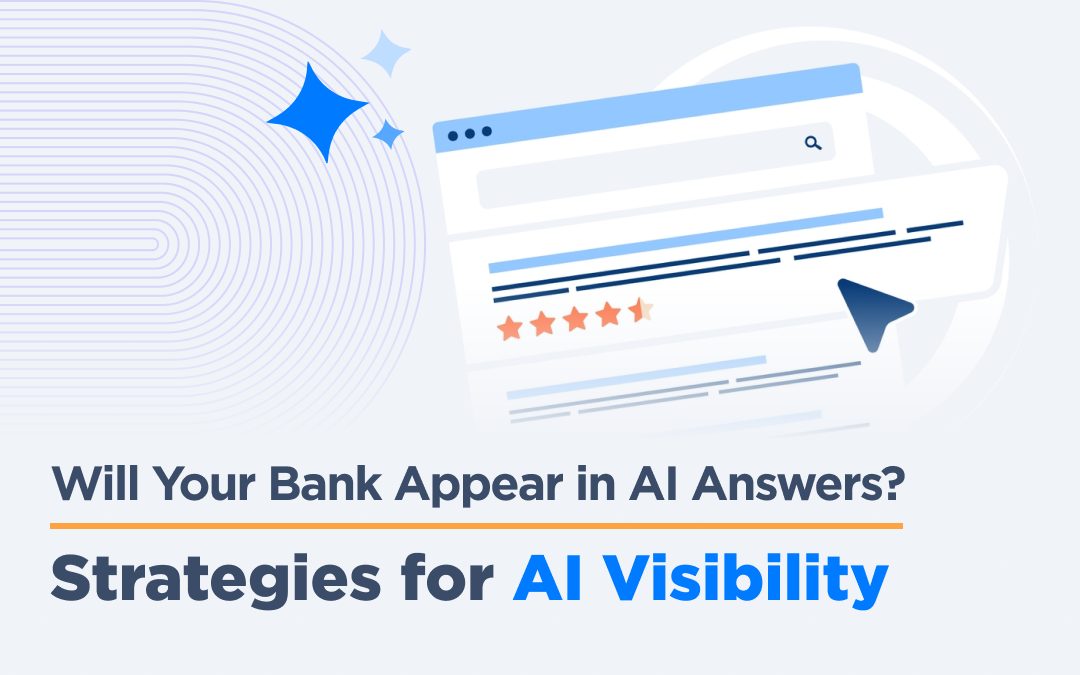
Wayne Cichanski, Vice President of Search and Site Experience at iQuanti, identifies the six core signals that determine whether your content is cited by AI search engines.
During a recent webinar hosted by American Banker, Wayne Cichanski, Vice President of Search and Site Experience at iQuanti, shared how AI-powered search engines retrieve, evaluate, and surface financial content. The discussion explored how large language models (LLMs) determine which brands are included in AI-generated responses and why financial institutions must rethink visibility strategies in the era of AI Search. As AI-generated answers increasingly shape customer journeys, AI search optimization for banks is becoming a critical component of modern SEO for banks and broader SEO for financial services strategies.
The challenge for financial brands today is no longer just ranking on search engines. Visibility is increasingly defined by whether a brand is selected and cited within AI-generated answers. As platforms like ChatGPT, Claude, and Google AI Overviews become more integrated into consumer behavior, users are receiving direct responses instead of navigating through multiple websites. According to industry reports referenced during the webinar, AI-generated summaries such as Google AI Overviews now appear in nearly one in five searches. This shift is reshaping SEO for banks and forcing marketers to rethink traditional discovery strategies.
The link between high rankings and AI citations is weakening. Ahrefs data shows that only 38% of AI sources currently rank in the top 10, a sharp decline from the previous 76%. Remarkably, 1-in-7 cited pages don’t even appear in the top 100 results, proving that AI selection follows a different set of rules than traditional SEO. This evolution is driving greater focus on AI search optimization for banks, where authority, extractability, and trust increasingly influence visibility.
This shift is fundamentally changing how digital discovery works. Traditional SEO focused on driving clicks through rankings. AI-powered search prioritizes retrieval, synthesis, and trust. Instead of presenting users with ten blue links, LLMs aim to resolve the entire query within a single answer. For financial institutions, this means SEO for financial services must now extend beyond rankings and incorporate retrieval-focused optimization, structured content, and entity trust.
To remain competitive, marketers must master the four-stage engine that drives AI responses: Query Understanding, Retrieval, Filtering, and Synthesis. Each of these stages requires a specific set of optimizations to ensure that content is not only found but actually used to build the final response presented to the user. As AI-generated discovery evolves, modern Banking SEO strategy and Banking SEO best practices will increasingly depend on how effectively content can be retrieved, validated, and synthesized by AI systems.
The Four-Step LLM Process Financial Institutions Must Master
Cichanski explained that AI-powered search operates through four interconnected stages: Query Understanding, Retrieval, Filtering, and Synthesis. Unlike traditional search engines that rely heavily on keyword matching, LLMs interpret intent much more contextually by evaluating user goals, surrounding context, background information, and implied follow-up questions. Queries are no longer treated as isolated keywords. They are interpreted as broader informational tasks.
The retrieval phase pulls information from search indexes, trusted websites, pre-trained knowledge bases, and broader digital sources. Ranking still matters because content outside top search positions is far less likely to enter the retrieval pool used by LLMs. However, retrieval alone does not guarantee visibility within the final AI-generated response.
The filtering stage evaluates authority, relevance, consistency, extractability, and trustworthiness. At this point, AI systems narrow thousands of indexed pages into a much smaller set of validated sources. Finally, synthesis combines information from selected sources into a single generated answer.
This creates a fundamentally different competitive environment for financial brands. Institutions are no longer competing only for rankings. They are competing for inclusion within the final synthesized response. As a result, AI search optimization for banks is becoming essential for improving visibility, trust, and citation potential within AI-generated answers.
Six Core Signals That Determine Citation Eligibility
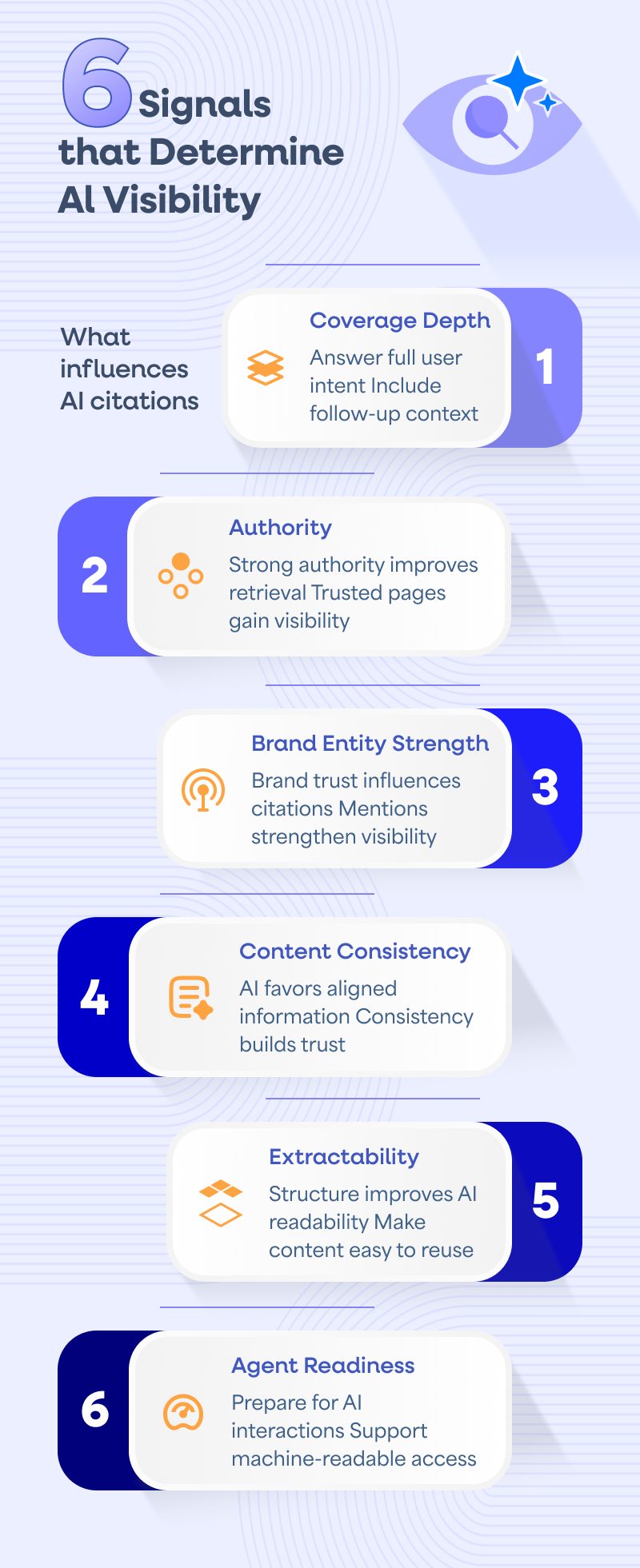
Cichanski presented six essential signals governing LLM inclusion. Coverage depth claims priority position. Exceptional pages resolve core intent alongside supporting concepts, edge cases, and anticipated follow-up questions. Content evolves from single-intent constructs into comprehensive mini knowledge hubs.
Authoritative value maintains relevance for retrieval prioritization. Content depth determines synthesis participation. Brand strength and entity strength manifest holistically across signals. Extractability guarantees bot accessibility to structured code elements. Agent readiness encompasses preparation for agentic AI systems, including Web MCP coding protocols.
These signals necessitate content strategy evolution. Business-as-usual approaches optimized for Google search prove inadequate. Financial institutions should audit high-priority pages against this framework.
Coverage Depth: Transforming Pages into Knowledge Hubs
Coverage depth demands strategic reinvention. The strongest pages deliver complete core intent resolution while addressing supporting concepts, edge case scenarios, and implied follow-up inquiries. Traditional Google optimization favored one page per discrete intent. LLMs prioritize interconnected knowledge hubs that eliminate subsequent search requirements. This shift is redefining banking SEO strategy and reinforcing the importance of AI search optimization for banks focused on completeness, contextual relevance, and structured information architecture.
A rudimentary “what is an APR” page consisting of two definitional paragraphs fails this standard. Leading content addresses calculations, delineates APR differences from interest rates, and contrasts fixed versus variable structures. Implied questions receive proactive treatment.
Cichanski illustrated through credit score improvement queries. LLMs deliver structured presentations featuring seven clearly delineated steps beneath descriptive headings. Responses extend to score-influencing variables, expected response timelines, and complete 30-day action plans. Structured list formats increase citation probability by 35 to 40 percent.
LLMs diverge from Google in objective. Traditional search encourages continued exploration. AI systems strive to fully resolve informational needs. Banks develop interconnected content hubs. High-volume edge cases warrant dedicated pages featuring strategic topical overlap. Completeness supersedes partial relevance.
The Four ‘Ables’ Framework: Precision Content Strategy Guidance
Cichanski introduced the four Ables as a content strategy compass. Retrievable content achieves sufficiently high rankings for crawler discovery. Extractable material employs clean HTML structures. Citable elements function independently as standalone quotes or sentences. Reusable components integrate into LLM knowledge bases.
Optimal content anatomy encompasses core intent matching alongside edge cases, subtopics, implied questions, and anticipated follow-ups. Travel rewards card pages address brand-specific benefits, lounge access protocols, and enrollment prerequisites. User experience teams may resist expanded page length. Cichanski recommended establishing traffic visibility as the prerequisite condition.
Structured elements prove transformative. Hierarchical headings provide clear navigational pathways. Lists and frequently asked question sections deliver accessible information optimized for extraction.
Clarity and Consistency Are Becoming Competitive Advantages
Another important insight from the webinar was how AI systems evaluate clarity and consistency. LLMs are designed to reduce ambiguity and minimize hallucinations. As a result, they prioritize content that is direct, explicit, and widely validated.
A vague statement such as “Several factors influence your score” is far less effective than a direct explanation stating that credit utilization above 30 percent can lower a credit score. The second example is easier for AI systems to validate, extract, and reuse because it provides a measurable and clearly structured explanation.
Financial institutions operate in a high-trust environment where accuracy and credibility directly influence consumer decisions. AI systems increasingly prioritize content that is consistent, validated, and aligned with broader consensus, making trust a foundational element of effective AI search optimization for banks.
Why Structured Content and Formatting Matter More Than Ever
The webinar also emphasized how formatting directly influences AI visibility. Structured headings, numbered sections, concise paragraphs, semantic HTML, and clearly organized content improve extractability and allow AI systems to process information more efficiently.
This creates a major shift in financial content strategy. Historically, banking websites often prioritized compliance-heavy long-form pages that were difficult to scan and difficult for machines to parse efficiently. AI-driven discovery changes that dynamic. Structure, clarity, and readability are becoming increasingly important competitive advantages.
The Future of Financial Search Will Be Defined by Trusted Sources
AI-driven discovery is changing the rules of digital visibility for financial institutions. Traditional rankings still play a role, but modern AI search optimization for banks increasingly focuses on trust, extractability, contextual relevance, and citation potential within AI-generated responses.
For financial institutions, the implications are becoming increasingly clear. Success in AI-driven discovery will depend on building comprehensive content ecosystems, strengthening entity trust, improving structured content, increasing extractability, and creating experiences that fully resolve customer intent.
As AI-generated answers continue reshaping financial discovery, the brands that establish themselves as trusted sources within these systems will be best positioned to influence future customer decisions.
This article is based on insights from our webinar, “Will Your Bank Be Cited When Customers Ask AI?” Watch the full webinar to explore the complete discussion and key strategies. To explore how financial brands can win with a holistic search framework in the AI era, get in touch.