Tony Hooper, SVP of Client Partnerships at iQuanti, and Irina Klein, CMO of BMG Money, discussed the importance of a holistic search framework in the era of AI-driven discovery.
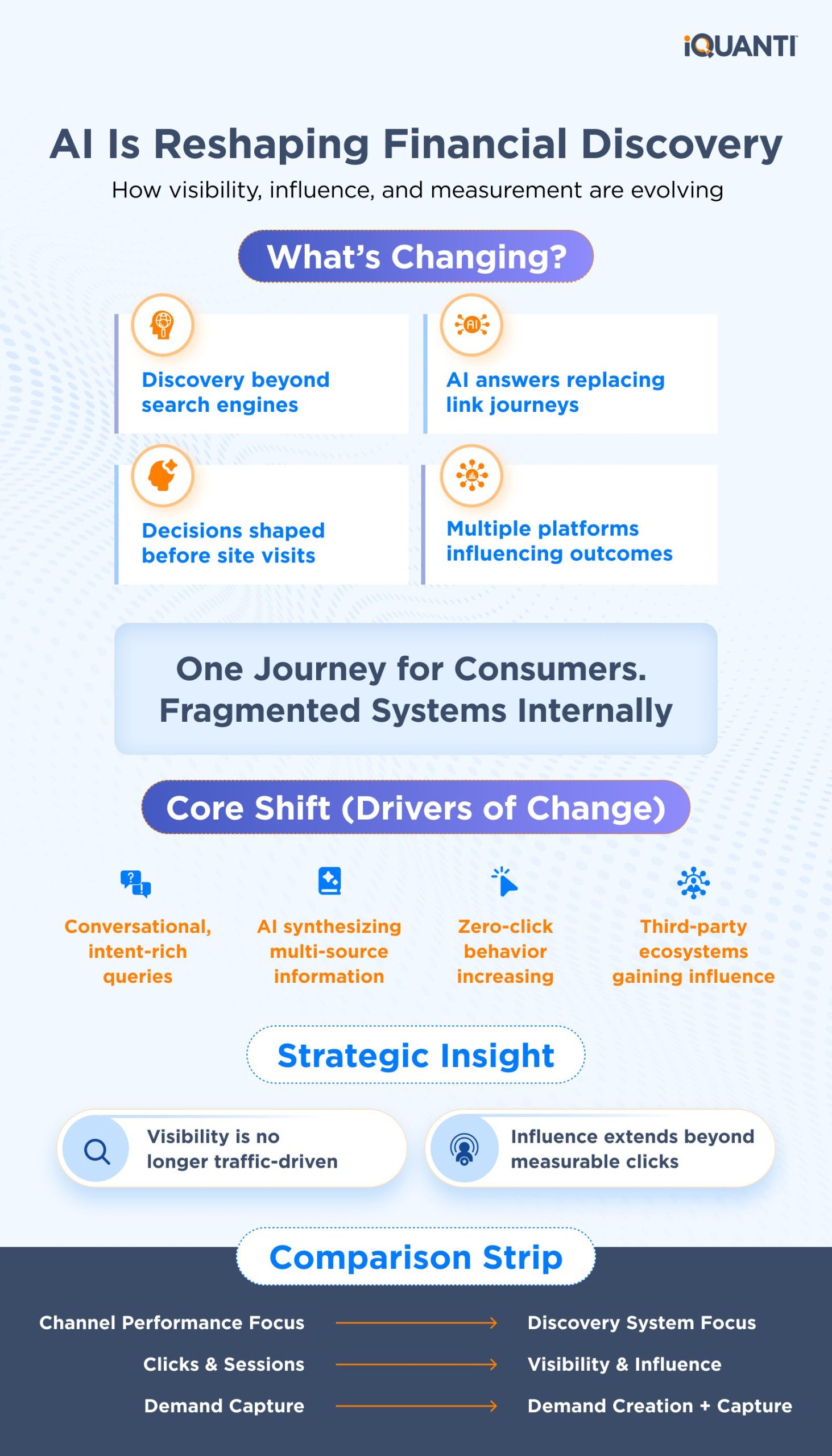
AI-driven search is fundamentally reshaping how decisions are made. Users are increasingly presented with synthesized, recommendation-led responses that combine information from multiple sources, often eliminating the need to visit individual websites. This shift is giving rise to what can be described as “influence without interaction,” where brand perception and consideration are shaped before any measurable engagement occurs. In financial services, where trust and comparison play a central role, this dynamic is particularly significant. Visibility is no longer defined by clicks alone, but by whether a brand is included in the answers that guide early decision-making.
Search is becoming less predictable and increasingly difficult to isolate as a standalone channel. AI-driven results are reshaping where and how financial brands appear, reducing the effectiveness of keyword-led strategies as intent and context to take precedence. As intent and context take precedence, discovery is influenced by signals beyond bids and match types.
This shift requires marketers to move beyond channel-level optimization and manage discovery as an integrated system. Visibility is now shaped across organic search, paid media, AI platforms, and third-party ecosystems. Consumers experience this as a single, continuous journey, while organizations continue to operate across multiple channels and teams, creating fragmentation in strategy, measurement, and investment decisions.
Consumer behavior has also evolved. Queries are more detailed and context-driven, prompting platforms to deliver synthesized, recommendation-led responses.
This requires a fundamental pivot in how we value search. Traditional metrics like sessions and CTR are insufficient because they ignore the brand’s presence in the AI’s thought process. Modern strategy focuses on Generative Engine Optimization (GEO). This involves optimizing technical foundations and content authority so that LLMs consistently reference your brand as a trusted source.
Such an approach must account for how AI is reshaping discovery across organic, paid, and LLM-driven ecosystems, while improving media efficiency through incrementality and cross-channel coordination. It must also establish a clear link between visibility and real-world outcomes, including applications, calls, and in-branch conversions.
Given the fragmentation of signals and the overlap between channels, marketing mix modeling becomes essential. These approaches provide a more accurate view of channel contribution, enabling organizations to align investment decisions with measurable business outcomes.
The Challenge of Organizational Silos
Despite this shift, most financial institutions still operate using channel-based structures. SEO, paid media, affiliates, and offline acquisition are managed independently, each optimized for its own KPIs rather than the customer journey.
Consider a credit card acquisition journey. A user may start with an AI query, validate options through a comparison site, encounter paid media, and ultimately convert via a call center or branch. For the customer, this is one continuous journey. Internally, it is fragmented across teams with no unified view of impact.
This fragmentation creates a fundamental measurement gap: organizations cannot clearly distinguish which investments are expanding discovery and creating new demand, and which are simply capturing intent that already exists.
What This Means for Discovery Strategy
The shift toward a “Search Without Silos” model requires a fresh approach to how brands maintain visibility. In the past, campaigns were organized around specific keyword groups. Performance was optimized by adjusting bids and refining keyword lists. Now, platforms focus on understanding intent rather than matching exact keywords.
AI search is fundamentally changing user behavior through zero-click interactions. Information is delivered instantly within results, removing the need to visit external sites. This makes traditional metrics insufficient, pushing marketers to redefine how they track performance. Success requires moving toward a model of “influence without interaction,” where brand authority and trust signals become the primary drivers of discovery. As a result, visibility across the entire journey matters more than performance within any single channel.
Framework for Discovery Management
To navigate this environment, a framework is required that moves from channel optimization to holistic discovery management. This shift involves several critical layers that allow teams to act on integrated data rather than isolated metrics:
Landscape Understanding: Acknowledging that discovery spans multiple surfaces, including organic search, paid advertisements, AI answer engines, and offline channels.
The Measurement Layer: Moving beyond click-based attribution toward the quantification of discoverability. A unified view, such as an AI Search Command Center, is required to establish performance baselines and identify correlating factors between visibility and business outcomes. This layer brings together data from SEO, paid media, AI visibility, social and offline signals into one system, enabling a holistic view of performance. It also allows marketers to evaluate which channels are creating incremental demand versus capturing existing intent.
Testing and Hypothesis: Utilizing unified data to identify the relationship between visibility and real business results. Teams can then pilot strategies across content creation, authority building and technical foundations. This approach enables continuous testing of how changes in one channel influence outcomes across the entire discovery ecosystem.
Organizational Orchestration: The implementation of cross-functional pods aligned to specific product lines. This structure ensures that content, analytics, and media specialists operate within an integrated framework to drive unified strategic outcomes. This alignment reflects how consumers engage with brands, even if internal structures remain channel-based.
From Volume to Value in Search Performance
Performance metrics are no longer as straightforward as they once were. High traffic and conversion numbers can suggest success, but they do not always reflect true growth. In many cases, especially in search, strong results are driven by users who already intend to engage. This creates a gap between perceived performance and actual contribution.
Understanding where new demand is being generated versus where existing demand is being captured is essential. A more integrated view across channels allows organizations to identify real growth drivers and allocate investments more effectively, ensuring that marketing efforts are expanding reach rather than reinforcing existing intent.
Implications of AI-Driven Conversational Search
Search is no longer a channel to optimize but a system to manage. Semrush’s analysis of AI Overviews finds that roughly 60% of Google searches now end without a click, as AI‑Overviews and SERP‑embedded answers satisfy intent directly. AI‑driven answers appear in about 15–18% of queries, reshaping how brands capture visibility and intent. Leading brands track AI Share of Voice, where strong entity authority can yield 3–5 times higher mention rates in AI‑generated responses versus competitors. For financial institutions, this means moving beyond siloed “SEO” and “paid” structures to understand which investments create demand (e.g., thought‑leadership, ecosystem partnerships) versus merely capturing it. The strategic question is no longer how to “win search,” but whether organizations are structured to compete in a world where discovery is continuous, distributed, and increasingly shaped by AI‑driven systems.
This article is based on insights from our webinar, “A holistic framework for banks & financial services.” Watch the full webinar to explore the complete discussion and key strategies. To explore how financial brands can win with a holistic search framework in the AI era, get in touch.